Wednesday, 23 March 2016

SIM cards, ward offices and banks – Fun Times in Tokyo

After finishing a game of FIFA against a work colleague, I received this message from him: "Good game. Let's play again soon."

I replied: "Cheers. Actually, I'm going to be offline for a while, I'm moving to Tokyo."

After sending that message, I realised how ridiculous it sounded. Moving to Tokyo is a concept so ludicrous that it was used to write the kooky character off Girls.

Fast forward a few days, and I was on a plane descending into Narita Airport.

I had a lot of emotions running through me, but my overriding thought was: "I've got a lot of shit to do."

The company I work for required me to complete three objectives before I could start:

1. Obtain a Japanese mobile
2. Register at the local ward office
3. Open a local bank account

On top of that, I needed to go to the estate agents to move into my new room. I had to do all these things by Friday 15th; I arrived at noon Tuesday 12th.

I left the Arrivals lobby and retraced my steps from my holiday last year. I stayed at the same hotel as before, not because I was enamoured with the service, but simply because I knew how to get there. The only deviation was that I got out of the right train station. The moment I emerged out of Ochanomizu Station was when deja-vu smacked me. The only place I've been back to multiple times is my home in London, so to have this feeling thousands of miles away was very surreal. By the time I got back into the hotel (not the same room but the same layout), I hadn't slept in 24 hours, but dammit, I had work to do.

I strolled around Akihabara, admiring the various new anime and gaming billboards. However, my trip around wasn't just to gawp at the SEGA Arcade; I needed to buy a SIM card from Odabashi Camera – a massive 9-floor shop.

My sleep-addled body stumbled around the mobile section; I made two loops around the floor before I found the SIM corner. I shuffled through the packs of cards on display before I finally found it nestled in the back, the b-mobile Unlimited Data SIM.

The SIM card provides unlimited data for only 5000yen a month with one downside; it's a data-only SIM, so no calls or texts. I purchased a Japanese Skype number to get around this, which means I can phone anyone as long as I got an internet connection (smug face emoji).

After a night of Japanese TV and SIM installing, I promptly awoke early the next day and chugged my bags to the estate agents in Shinjuku.

The name of the agent is Sakura House; they deal exclusively with foreigners in Japan. When I went over, the mood was hush. The company's Facebook page had led me to believe that the Sakura House office was rocking 24/7. I couldn't believe that someone would exaggerate on Facebook. I signed all the contracts and went on my way.

I live in an area called Uguisuidani, famed for its wide selection of Love Hotels. If Hotel Platinum isn't your thing, then Hotel Joy next door may be what you are looking for.

Lifting my luggage up the stairs made me grateful that I only lived on the 2nd floor. I threw my bags into my room and laid on my new surprisingly plush bed. I sprung up after ten minutes because now it was time to register my address at the local ward office. This is a requirement for all long term residents. I chose to walk the twenty minutes to Taito Office. Even though scenic Ueno Park is close by, all I learned from my trek is that you're never two minutes away from a convenience store in Tokyo. My initial fears that I wouldn't find the building were availed when I noticed it a mile away.

Once inside, I scanned around for any hints written in English that could help me find out where to go in this massive labyrinth. Finally, I conceded defeat; I had to use what I had been too shy to utilise: my undeniable charm.

Also, my broken Japanese.

The first couple of exchanges were conducted by the art of gesturing; the old man at the counter pointed at the form, "Namae!" he said.

"Yes!" I thought. "I know that word!" ("Namae" means name if you hadn't figured it out).

Next, a suited man looked over my files; I handed him my resident card. He looked at the front. "Kino kimashita?" he asked. I replied with a confused "Hmm?" He shook his head as if to say, "never mind." It took me a few moments to realise he asked: "Did you arrive yesterday?" That was in Volume 1 of my Japanese textbook! Following some scanning and stamping, the man took my resident card so he could imprint my new address. As he got up from his chair, I stammered out

"Do…Donogurai? (How long will it be?)." His eyebrows arched, he turned back. I wondered: "Did I say it right? Please don't make me repeat myself." he outstretched two fingers and said.

"Nijuppun. (Twenty minutes)". Never has a council visit been so tense.

As I left, I noticed another foreign man who brought a Japanese friend to translate. Bah, amateur.

The last part was the most simple, opening a bank account. I was recommended Shinsei Bank. I choose to visit a branch where there were English speaking staff. Once I walked into the door, I stumbled out the phrase "Ginko akemasu" (literally means "bank open."). I motioned opening a book with my hands to illustrate the point further. The receptionist, noticing my caveman ways, spoke back in perfect English, "Please take a seat; someone will see you shortly." I dealt with another English speaking staff member to open my account.

I finished all the tasks set out to me and with a day to spare. As I headed back to my seedy town, the thought of spending my first weekend alone in Tokyo felt like a let-down. My housemates were not what I imagined (more on that later), and I wouldn't meet my co-workers until Monday. This was unlike America and China, where I was a part of a big group of newcomers. If I wanted to meet people, I had to be proactive.

I recalled an e-mail I got from Sakura House detailing a list of events for the month. Amid events such as flower watching and walking tours, I saw that there was a New Year's party on Friday. I usually turn down events such as these, thinking that organised fun is beneath me. Also, the thought of being at a party and not knowing anyone is more terrifying than explaining True Detective Season 2. Nevertheless, I e-mailed Sakura House telling them I'll be there.
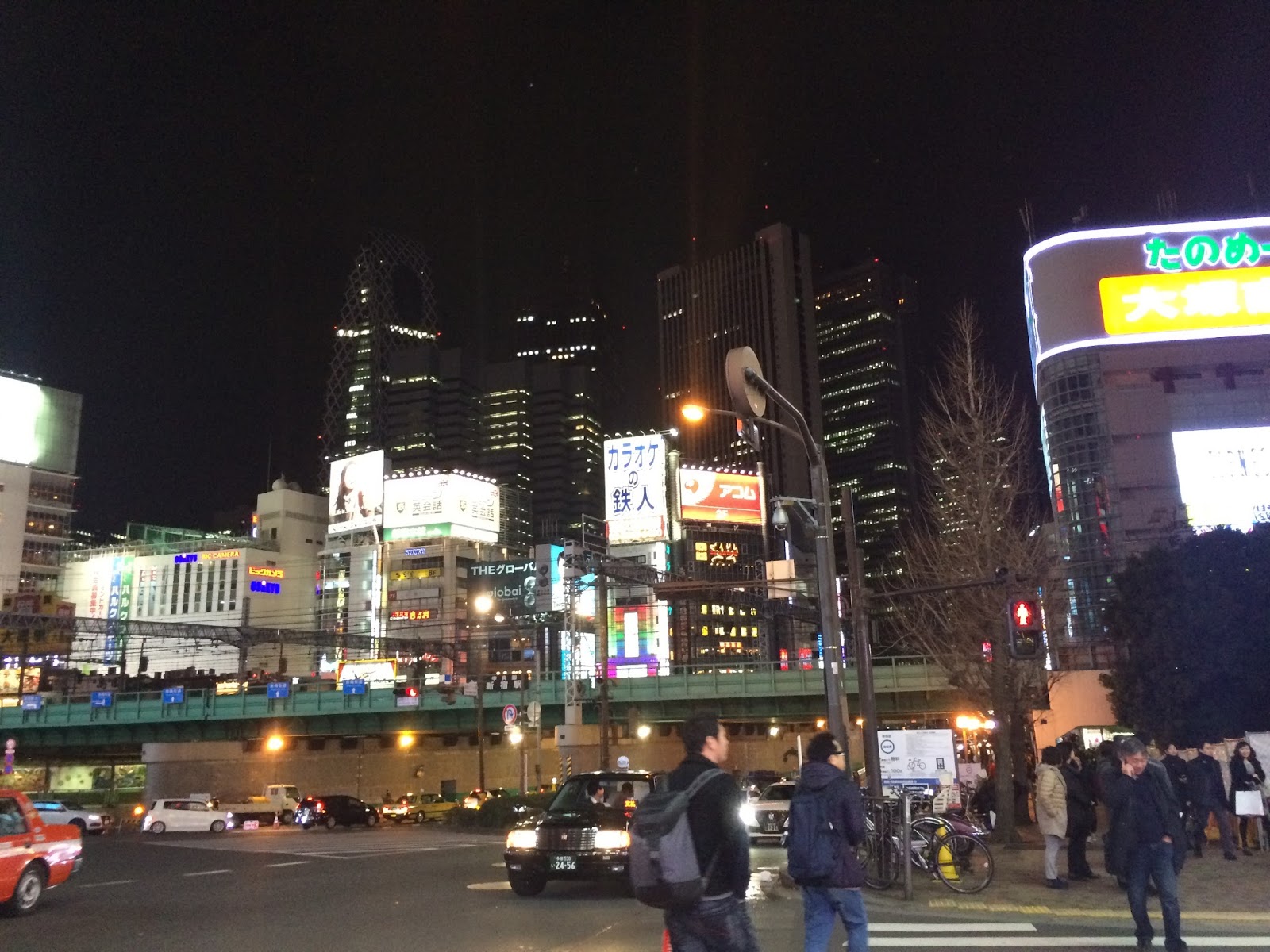
I arrived at the venue the next day at 6 pm on the dot, thinking that everyone would be as punctual as me. Clearly, I had forgotten Rule 1 of a party: Never Be Early. I walked into the lobby of the Sakura Hotel lobby, nary a soul in sight. I approached the clerk behind the clerk. "Pa…Party…?" I asked.

"Sure!" the clerk exclaimed; I then handed him the 500yen entry fee that got me a free drink and snacks.

"Oh, me too!" said a blonde-haired woman directly behind me. A few moments later, a man with a hoodie and frazzled hair showed up; this party is rocking! He wrote his name on his sticker; the woman exclaimed, "Ah! Are you Italian too?" This party sucks.

As the two conversed at length in their native tongue, a man with an Oklahoma hoodie strolled in. My kind of guy. I spoke with him at length about Oculus and how VR will be the end of mankind. While we were chatting, the room filled.

I met a plethora of people from all over the globe, but the most interesting was this tall goateed Japanese man. I asked him what he did. He replied: "Cage Fighter."

I'm a big mixed martial arts fan, so I pried more. "I fought in Sengoku once," he answered. Sengoku was one of the biggest companies in Japan. I couldn't hide my glee that I was meeting a professional MMA fighter. "But I lost," said the tall MMA guy. "I don't fight anymore."

Everybody started filing out shockingly early; I inquired as to why. It was here that I learned that Tokyo's trains close at around midnight. Night buses are non-existent, and taxis prices are so ludicrously high that most people opt to sleep in the station and catch the first train back then catching a cab.

The ex-fighter was loitering around outside; we started talking about China. "Oh, I fought in Macau," he said. "I lost." (I looked up his MMA record later on, it wasn't pretty).

As I got on the overly-packed train, I felt upbeat about Japan and my time here.

Next time, I will go over my antisocial neighbours, meetups and the Choco Potato.

Bonus Sanji pic

Thursday, 31 December 2015

First Time in Japan

The plane ride from Shanghai to Tokyo was the easiest flight I'd ever been on.

I had lunch, blinked and was there. I was with Sam, a friend I met in Shanghai. She had never been to Japan either and had a very cool boss who let her take time off with little notice.

I meticulously planned our journey from the airport to the hotel:

1. Get through immigration and down to the ticket desk
2. Purchase the tickets, take the Narita Express to Tokyo Station
3. Take the Marunouchi Line at Tokyo Station to Ochanomizu Station
4. Walk the wrong way for twenty minutes…FUUUUU.

After walking out of Ochanomizu Station, I chugged my heavy bags down a long road. As I approached the corner, a large egg-shaped stadium came into view; it was the Tokyo Dome. The wrestling fan in me drew a huge grin, knowing that was the venue for many legendary bouts. However, I was slapped back from my stupor when I realized that the hotel was on the other side of town.

Whilst looking at a street map, an older Japanese man with greying hair and a suit approached us, "Do you need help?" he quietly asked in English. Before I could respond with the Standard English response ("Nah, you're alright"), Sam interjected, "Yes, we need to get to this hotel." He pointed us in the general direction of the place.

After gathering ourselves, we went walking towards where the man directed us. I spotted him from the corner of my eye sheepishly waiting for us; he approached us and asked again where we were going; the man deciphered our English address into Hiragana. "Oh! Twenty minutes, that way." He exclaimed, "I'll take you there."

After leading us around Tokyo's backstreets, the man stopped and asked for directions from a shopkeeper. Much later, we arrived at a busy street; I listened attentively when he told us to "go straight here." We thanked the man graciously for his help. He was embarrassed for the praise, as if helping two strangers for over half an hour was just something you do.

The rest of the trip was fantastic, albeit not an exciting read unless you want an in-depth analysis of the hour I spend inside the Mega Pokémon Center.

I only managed to get us lost at one other point: after leaving a shopping centre, we took the wrong exit and ended up smack dab in the middle of a pachinko parlour. Now, I've never been in a warzone, but I have played a lot of Call of Duty, and that parlour reminded me of the scene where the helicopters fell from the sky in Modern Warfare 2. It was hard to tell which was louder, the hundreds of metal balls clanging together or the blaring sound effects the machines made.

I yelled to Sam, "I think we need to go this way!" I successfully led us to a room with… another set of pachinko machines! While trying to find a way out, I noticed that the parlour staff had earplugs, but the customers sat leaned back with no ear protection, as if they were immune to the chorus of hell surrounding them.

We somehow emerged out; I needed a few whiskeys after to forget.

Adjacent to the hotel was a shop that served as my introduction to the amazing world of Japanese convenient stores – or "konbini" as they are known over there.

This konbini was a FamilyMart, a convenience store chain that can be found all over Asia. There was a FamilyMart located next to where I stayed in Shanghai, although that shop paled in comparison to its Japanese counterpart.

Konbini's are open 24 hours, have seating areas and stock a wide selection of warm and cold food that forced me to rethink my opinion on the Tesco Lunch Deal. Such is the power the konbini wields, that McDonald's and Starbucks Japan both had to rethink their strategy after FamilyMart start serving fries and coffee. You can also do many other activities inside a konbini such as paying bills, photocopy and collecting parcels. On my last morning, I shunned all of the delicious and unique food that Tokyo offers for a fried chicken + rice combo at FamilyMart.

During the gruelling 22-hour flight back (including a mere 2-hour stopover in Dubai), I decided to head back to Japan soon. Fast forward to today, and that time is very soon; I leave for Tokyo next week; I shall be there for the whole of 2016.

In preparation, I've been studying Japanese. The main reason I'm learning is for survival. As I learned on my previous trip, Tokyo is not as easy to get around for foreigners as Shanghai is.

Another reason I'm learning is for the surprise factor. In China, a big group of rookie teachers and I went to a restaurant; included in this group was a randomer from the hotel we were staying at. All I knew about him was that he was a white guy with a jumper two sizes too big. While seated in the restaurant, the waitress approached our group for the order; Mr Baggie Jumper answered in Chinese, the whole table awed. My first thought was, "Man, fuck that guy." I had to concede, though, that was impressive (his Chinese ability, not the jumper). I eagerly await my moment when I stun a group of people with my broken Japanese.

I plan to document my thoughts, adventures and certain mishaps. Stay tuned.

おたのしみに

Thursday, 9 April 2015

Ting Bu Dong – My Time in Shanghai

It was around Christmas when I received my Work Permit.

I had applied to teach in China a few months earlier, and the arrival of the Permit marked the end of a longwinded process. I emailed my recruiter in Beijing; he rang a few days later. "Oh, hey, we're going to need you here by the 6th," he said.

"The 6th? Of February?" I replied.

"No. January."

"Bu… That's next week!?"

"Haha….yeah…"

I hastily packed up my things and moved to Shanghai.

I taught English in the company's Adult Centre. There were a varied bunch of students, but they did have one thing in common; they all made more money than me. I taught designers, lawyers, and a lot of engineers. The most interesting job belonged to a student named Celine; she was a video game designer for Ubisoft Shanghai. Celine designed the crowds for the Assassin Creed series. Her excited giggle at my Ubisoft account made all those years of collecting UPlay points worthwhile.

Many students came to the centre daily, fitting English lessons around their demanding jobs. One such student was Renber. A jovial fellow, Renber was a singer, drama teacher, and actor. On stage, he sang Chinese versions of famous English songs. His reason for learning English was to get "closer to his art." Despite being the most accomplished man in the building, Renber was incredibly humble and attentive, especially when he took advice from this rookie teacher.

Renber hosted a special singing lesson one Saturday in the centre. I learned the most valuable lesson in all my time in China, how to sing from your nose. Renber brought over one of his pupils who sang an impromptu rendition of I Dreamed a Dream. There was very little English taught that evening.

My view from the office

The internet situation in China has been well documented. "VPN" is a commonly thrown around term between ex-pats. Even worse than the lack of RedTube is the internet speed in the country. It was so slow; it left me pining for the days of dial-up. To occupy my time, I turned to the CRT TV in my room. Thankfully, the hotel had HBO Asia, which played non-stop movies. I finally saw Mean Girls and immediately understood 80% of Buzzfeed.

In contrast to the broadband, China's mobile internet speed is remarkable and somehow works underground on the Metro. The Chinese have an extra special, Joaquin-Phoenix-in-Her love affair with their phones. It's commonplace to see whole train carriages staring intently at their mobiles. Multiple times, I witnessed diminutive Chinese girls dart past bodies on busy platforms with cat-like reflexes, all the while still glued to their phones.

China's smartphone obsession sometimes gets in the way of their jobs. During a cab ride back, our cabbie would pick up his mobile every time he got to a stoplight to watch a movie. He would grumble whenever the light turned green. All that pesky driving got in the way of the newest 2 Broke Girls.

I mostly stuck to the Metro even though the service closed ridiculously early; most services would shut by 23:00. Getting onto the platform was also a hassle. There were security checkpoints at each train station; all bags had to be put through a scanner. However, the only people who placed their bags on the scanner were nervous foreigners like me; the vast majority just walked on by. Despite these grumbles, the service did always run on time, and the price converted from CY to GBP is 30p for one journey. Londoners, I'll let you catch your breath.

Shanghai is truly an international city, which is a fancy way of saying, "You don't have to speak Chinese here." I met many Westerners living in Shanghai for several years despite possessing only 'Survival Chinese.' In my first few days in the country, I picked up two essential phrases: "Ni Hao" and Mi Fan." "Hello" and "Rice."

The only time my erm…' lack' of Chinese proved a problem was when a scruffy man on The Metro asked me for directions. I was boggled why this crusty was asking me, considering there was a train full of people who were far more qualified. I later learned from a local that this man was messing with me, and that is a common joke played on foreigners. Afterwards, I added a new phrase to my collection: "Ting bu dong." "I don't understand."

All of those papers were Sherpa's bills

After the honeymoon period ended and I craved western food, Sherpa's was there. Sherpas is Shanghai's biggest delivery service (identical to JustEat in England) with a full English language version of their website. My favourite place to order from Sherpas was called Mr Pancake House. One of the only places that served an all-day English Breakfast, I shamelessly ordered from Mr Pancake's multiple times a week.

Restaurants were a bit dicey; many have menus with English translations. When they didn't, I would point-and-pray. The most bizarre food I ended up eating was a frog (tasted like chicken), which I know of.

Booze is outrageously cheap. A Tsingtao bottle is 5 CY (around 50p) at a convenience store, and the bottle size is twice that of regular western containers. Expat bars, though, are to be avoided. The cost of a drink in these places is high, even for London standards. One bar that does get my approval is Demarcia. My fellow rookie teachers and I stumbled upon this place on our second night. Located near Jiao Tong University, Demarcia blares out mid-noughties hip-hop and serves cheap drinks. My first visit happened to be Free Beer Night. That's right. Free. Beer. For one hour only and the offer only applied to the cheapest beer (Tsingtao). But still. Free. Beer.

This suave statue was to commemorate the Year of The Sheep

I never got to branch out and see the 'real China.' Instead, I quickly got engrossed in teaching; Shanghai (and China) just became the backdrop. It was both the most challenging and most rewarding job I've ever had. The biggest compliment I got was after I wrapped an hour lesson. A bemused student chimed, "It's over already?!"

After leaving China, I took the short plane ride to Tokyo, fulfilling one of my lifelong dreams. But that's another story for another time.

Monday, 20 October 2014

Retro Review: Eternal Sonata

Originally posted on D-Pad.co.uk

Lost in the shuffle of Halo 3, Super Mario Galaxy, and the plethora of Triple-A games released in 2007 was Microsoft's umpteenth attempt to crack the Japanese market.

Eternal Sonata is an RPG centred on legendary Polish composer Frederic Chopin. Developed by tri-Crescendo, the makers of the Baten Kaitos series, Eternal Sonata takes place in an imaginary world conceived by a terminally-ill Chopin on his deathbed.

The story is based on teens Allegretto and flower-girl Polka's quest to stop the evil (and prepubescent) Count Waltz. The Count has raised taxes to a ludicrous level, and our heroes set out to obtain an audience with Waltz to air their misgivings. Instead, events escalate, threatening to throw the whole world into turmoil. Chopin himself features in the main story but curiously, as a side character. Chopin must have been a very humble man to consign himself a bit character in his own dream.

As the world is based in Chopin's mind, music plays a big part in Eternal Sonata; The main characters are named after musical terms (other than Chopin himself). Pianist Stanislav Bunin faithfully recreates Chopin's pieces. In addition, the game features original music composed by the prolific Motoi Sakuraba.

The game's events are inspired by Chopin's life story, such as the rebellion sub-plot, which has similarities to the Polish–Russian War 1830–31. Main heroine Polka suffers from a terminal illness similar to the one that befell Chopin. In the world of Chopin's dream, the side-effect of a terminal illness is the ability to wield magic. The story is complex and has many underlying themes, with no clear plot; the story is hard to invest in and will fade from your memory after completion. tri-Crescendo has to be applauded though, for creating a story based on high taxes and tuberculosis.

Two playthroughs are required to experience everything the game offers fully. Eternal Sonata's Encore Mode would suitably challenge hardened gamers. The mode is unlocked after one playthrough; the enemies in Encore deal out 1.5x damage, have 2x HP and are more aggressive in battles.

Despite being released over seven years ago, Eternal Sonata still looks impressive as it did in late 2007. The colours are vivid, and the cell-shading creates an Anime feature-film look. In addition, the monsters of Eternal Sonata are highly imaginative; watch out for the flying goat and oversized onion.

The PS3 version – released a year after the 360 game – includes exclusive playable characters and new areas. Regardless of the system, Eternal Sonata will satisfy underserved JRPG fans or those wanting to sample something different, which Eternal Sonata most definitely is.

Overall

Colourful, original and bonkers. Eternal Sonata is unlike any game this gen. The gameplay might not be revolutionary, but the vivid graphics, whimsical music and unique story hit the right notes

7/10

Sunday, 21 September 2014

Deadline Day Drama!

It was 2024 in Football Manager.

In this playthrough, I had accomplished a lot: Winning Euro 2020 with England, bringing the World Cup home in 2022 and lifting my first trophy in any FM game with my favourite team, Newcastle United (the Europa League). After a successful first season at Real Madrid, capturing La Liga and the Copa Del Rey, I aimed to win The Treble.

The Winter Transfer Window was about to close, and my last remaining RW, Agustin Allione, had been ruled out for three months with an injury. I needed to buy another Right Winger desperately. After a quick search, I decided to bring in disgruntled 29-year-old Raheem Sterling from Man Utd. I had worked with Sterling at Newcastle and in the England setup. After I departed for Real Madrid from Newcastle, they sold him to Man Utd, who proceeded to do nothing with him. Man U had no quibble to sell.

But I had depleted all of my sizable budget in the Summer Window after spending £70 Mil on forward Marcel Masio (a regen, or in other words - a fake player) and £66 Mil for Ballon d'Or winner Jack Wilshire. I had to sell someone.

I put 25-year-old Brazillian Paco (another regen) up for sale for £15 Mil (Man U were selling Sterling for £10 Mil). Paco could play LW, LM, CM and AM. I didn't want to sell him because he was valuable as a sub, but Paco had grown frustrated and had asked to leave earlier, so he was the obvious choice. He was a great player but wasn't good enough for the Real first 11. I quickly arranged a contract with Sterling, but Paco was fielding offers from a plethora of clubs and was taking his time signing with anyone. His payback for his time on the bench, no doubt. I had to delay and eventually cancel the Sterling deal due to a lack of funds.

It was now Deadline Day; I signed and agreed on terms with Sterling twice, only to cancel because that indecisive bastard Paco still hadn't decided on a team (and every time I rebid Man U drove the price up by £1 mil). Paco finally signed with a club (Spurs). After another bid and contract offer, I thought I got Sterling, but to my horror, the Madrid board took most of the transfer cash! The board left me with a paltry £5 mil. Sterling signed with AC Milan at the last moment of Deadline Day.

There was still a gap in my squad, so I bought up a youngster from Castilla, Joshua Oyala. A fairly promising winger. Trush in youth, eh?

I started him against Atl Madrid. His poor tackle cost us a penalty, the game and our undefeated record in the league.

...FUUUUU

Monday, 8 September 2014

Inazuma Eleven GO Review

Originally posted on D-Pad.co.uk

GO comes in two versions: Light and Shadow. The difference between the two games is minor: a few special attacks, teams, and a returning character from the previous Inazuma trilogy. This review is based on the Light Version of the game.

Released to coincide with this year's World Cup, Inazuma Eleven GO has finally dribbled onto our shores (GO has been available in Japan since Dec 2011).

Set 10 years after the original Inazuma trilogy, the game follows wide-eyed Arion Sherwind and the rest of the Raimon High School football team as they battle Fifth Sector. This corrupt governing body seeks to control every aspect of football (no relation to actual events).

Inazuma Eleven's unique blend of football, Anime, and RPG has failed to catch on outside of Japan, but could GO score the winning goal?


Behind GO's cheery exterior lies an engaging plot. Fifth Sector governs football with an iron fist going as far as predetermining outcomes of games. Fifth Sector orders Raimon High School to lose their opening game; with the urging of newcomer Arion, Raimon decides to go against the script and play to win. GO is structured like an Anime and the game's plot and art style is reminiscent of mid-2000 Anime's such as Beyblade and Yu-Gi-Oh. Occasional animated cutscenes appear in pivotal moments. Produced by the studio behind the Pokémon anime – OLM – these segments are of the highest quality. There's even a cheery Anime opening title that I guarantee you'll be humming within in a few days.

Arion loves 'The Football' (yes, he refers to football as a person) and won't stand for Fifth Sector's crooked approach to the game. Arion is a prototypical Shounen character in the vein of Goku from Dragon Ball and countless others, but that doesn't make Arion less of an affable lead. Other members of the team include the implausibly short, Jean-Pierre – or JP for short – and troubled Captain Riccardo Di Rigo. The character designs are outstanding, with each central cast member having a distinct look.

The great work done by Level 5 on design has been hampered by the localization team, who have given certain characters new 'English' personalities, the worst of which is midfielder Ade and his comical Geordie accent. Other English terms such as "Innit" and "Lad" appear innocuously. Whilst the story is left untouched, this unnecessary altering is a throwback to a best-forgotten chapter of gaming.


Matches are controlled via the stylus, with the buttons only used to move the camera. The controls are fiddly to get a hang off, especially for those not used to touch controls but the movements are intuitive enough for you to master as the game progresses.

There are two types of matches in GO; full 11 vs 11 football games and 5-a-side battles that the player can found around the game world. The 5v5 games are only 15 seconds, although time is paused whenever an action is being conducted, meaning these battles are closer to 1-2 minutes. A 5-a-side game can be triggered by finding an eager opponent on the game map (no random battles, thankfully). The requirements to win are winning the ball, keeping the ball (quite tricky) or that old fav, Next Goal Wins.

The big matches are much thornier. To advance the story, the game requires you to perform actions, such as getting a specific player (usually Arion) into the penalty box, which can be a pain with ten players hounding on you. Ironically, Inazuma's plot is centred on match-fixing, yet the big games are heavily scripted. At times it feels as if you're watching the story rather than playing it. After fulfilling said objectives, the game allows you to run free. Much like in the plot, that's when the game comes alive. Despite that grumble, the big games are bundles of fun and have a great atmosphere; you'll be raring to play the matches as if you're a member of Raimon yourself.

The learning curve is steeper than you would expect for such a 'cutesy' game. Curiously, GO doesn't display the opposition's level before a game, resulting in frustrating bouts against mini Tim Howards. However, that frustration is worth it for the oh-so-sweet moment you finally get one in the net.

GO introduces Fighting Spirits to the series- Inazuma's take on summoning monsters. Only select players can unleash Spirits. They are essentially clear shots at goal. The player can only unleash Spirits in story battles, but after completion, you can freely use them at any time.


Graphically, the game looks outstanding and is comparable to Level 5's PS2 title Dragon Quest VIII. Switching 3D on actually detracts from the visual. Leave that slider alone! The soundtrack is superb and perfectly meshes with the game. One gripe is the lack of variety in the music department. GO uses the same BGM whilst out-and-about in the game world and during battles. In critical moments though, the soundtrack accompanies the game beautifully.

Inazuma Eleven is unlike any series out in the market. If it was released a decade earlier, when Anime was still on television and Japanese games resonated outside of their home country, I'm convinced Inazuma would've achieved more success. The poor localization is regrettable, but it doesn't hinder the quality GO exudes. If you enjoy football, Anime, or RPGs, GO should have a place in your starting eleven.

Overall

Inazuma Eleven GO is a unique RPG boasting an intriguing story and charming characters, let down slightly by a shoddy localization. Perfect for young and old gamers alike, Inazuma scores a screamer.

8/10

Saturday, 12 July 2014

XBOX Event Report

Originally posted on D-Pad.co.uk

Microsoft brought E3 to a hidden corner of West London.

The company invited a select group of gamers and journalists to get hands-on with titles first previewed at last month's E3. I managed to wrangle myself itself an invite; here are some thoughts on the day:

Not announced beforehand, FIFA 15 made a surprise appearance at the event. A new feature touted by EA is Emotional Intelligence. Whenever players miss a shot, or a decision doesn't go their way, they are considerably more animated than before. But the issue of the 'dead eyes' persists. Other than that, the game looked great (the pitch degenerated through the match) and played superbly. Two new tactical options have been added on the side of Ultra Defensive and Ultra Offensive: Park The Bus and All-Out Attack, respectively. Unfortunately, I didn't get a chance to test out All-Out Attack, but Park The Bus is precisely just that. My entire midfield line raced back to the penalty box when I moved that slider all the way left.


Sunset Overdrive was the event's showpiece, with most of the screens in the room dedicated to Insomniac Games first Xbox title. What immediately stood out about Overdrive was the vivid colours. There wasn't a grey or black in sight. I was having so much fun blowing stuff up with the plethora of weapons on offer that I had to be reminded by an Insomniac employee on the objectives to be completed. Believe the hype.

Forza Horizon 2 continues to attempt to fill the hole left by Project Gotham Racing. Being quite rusty with the racing genre, I hit the curb once or twice (or fifty times). A neat addition for terrible drivers like myself is the rewind feature which allows you to turn back time and skid into a different hay bale.

The game that attracted the most attention was Evolve. The co-op FPS from the creators of Left 4 Dead garnered many awards at E3, including "Best of Show", and It was not hard to see why. Evolve is a five-player co-op game. One player plays as the monster whose role is to avoid the four others who seek to stop him. The beast gradually evolves (hence the title) throughout the game, with three levels in all. Expect the phrase "This isn't even my final form" to be uttered frequently. Playing as one of the chasing squad, I felt like a part of a sci-fi thriller. Eventually, we killed the monster just before it almost wiped out our entire squad. Evolve will be one to watch.


Fable Legends also implements the same four-versus-one concept as Evolve, but the two games are miles apart in terms of quality. The controls were muddled, and attacks didn't hit solidly. Granted, this was an early demo, but every other game on show is scheduled for release in a similar timeframe and didn't look as shoddy. It's time for Lionhead to leave Albion and create a game that is not Fable.

Assassin's Creed Unity and Halo: The Master Chief Collection were at the event but not playable to the public. The fellow demoing The Master Chief Collection for us displayed Halo 2 Anniversary's split-second toggling between the old and new visuals of the original Xbox title. This game is packed with features and will undoubtedly delight Halo fans.

Also on show was Alien Isolation and four ID@XBOX titles.